Local by Default, With No Account
Install Orchestra and your agent sessions and memories stay on your computer, in a store only you can open.
Three Commands
Install it, turn it on in a repository, and keep working with the agents you already use. On a Mac, the desktop app does all of this from its first screen.
orchestra enable- Only where you say. Sessions are saved only from repositories you turn on, and their worktrees.
- Secrets removed first. Redaction runs on your machine before anything is stored.
- Off the record when you want. Start a session that is never saved, now or later.
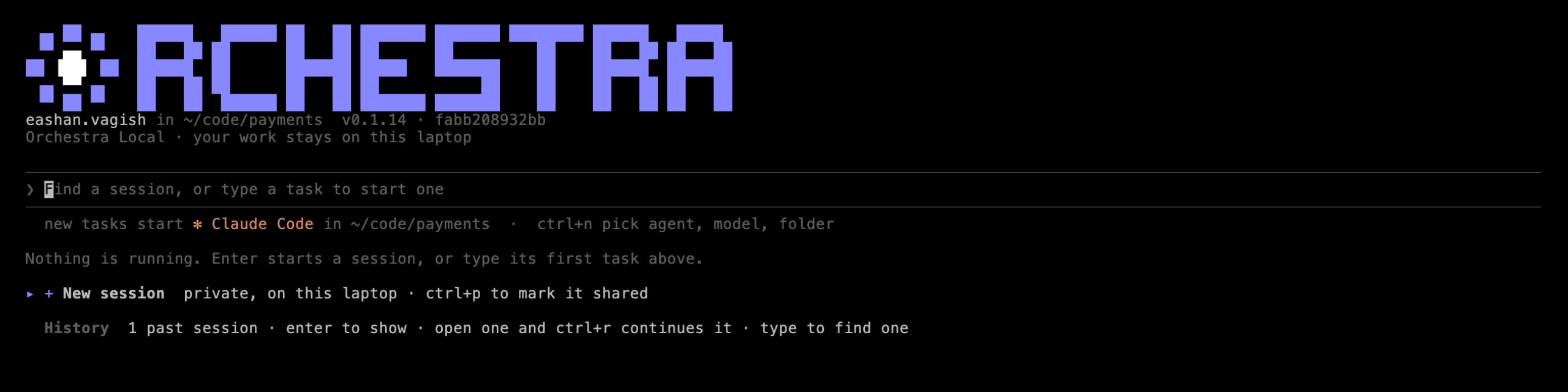
$ orchestra enable
✓ Sessions in payments and its worktrees are saved on this laptop. Other folders are not.
✓ The local daemon is answering lookups
✓ Memories are written with your own subscription or key, on your account.
Every new session starts private to you. Secrets are removed on this machine before anything is stored.
What Leaves Your Computer
Memory is written with your own Claude Code or Codex subscription, or your own key, so that tool sends what it reads to its own vendor. The CLI and app send small anonymous daily counts, which you can turn off, and the CLI checks for new releases. No code, paths, prompts or session content are in those counts.
orchestra telemetry offAI Is Building a New Silo, One Private Conversation at a Time
Code used to be the shared object. Now the real work happens in a terminal nobody else can open.
- Invisible while it runs. Nobody else can see the session, so two people chase the same bug.
- Gone when it ends. What was tried and ruled out leaves with the terminal.
- Stuck with whoever ran it. Your best engineer’s judgment never reaches anyone else’s session.
- Claude Code
Arnav’s terminal
why does the ingest test flake?
the clock is frozen in setup
Only you can see this
- Codex
Eashan’s terminal
retry the webhook handler
tried it, the race is still there
Only you can see this
- Cursor
Maya’s terminal
where do we redact keys?
looking at session context
Only you can see this
- Gemini CLI
Arnav’s terminal
why did staging run out of VMs?
nothing caps how many one team can start
Only you can see this
An illustration: four agent sessions, each in a terminal only one person can see
Orchestra keeps what your agents learn, and hands it to the next session.
Decisions, dead ends and open questions come out of every session, each one linked to the moment it came from. Your agents start with that context instead of starting from zero.
Start on Your Machine Today
Download the app or install the CLI. Local by default, with no account.